
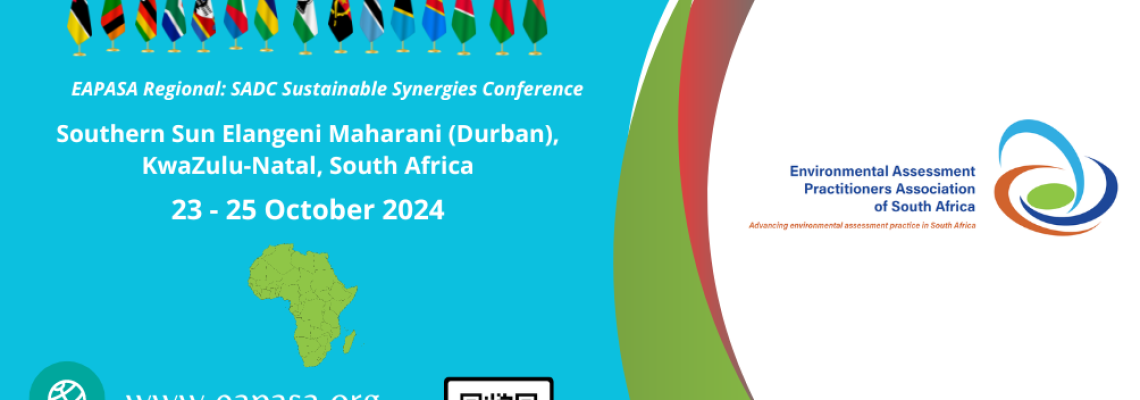
The EAPASA Regional Conference is an annual event that brings together environmental professionals from the Southern Africa Development Community (SADC) countries. The aim of the conference is to engage with other relevant professionals operating within the Environmental sector in Africa to find synergies that can assist in standardising the Environmental Assessment practice and develop guideline documents for Best Practice. These professionals can forge strong working relations, deliberate on critical environmental issues, and share knowledge on policies and legislation that best advances the environmental sector.
The 2024 conference will be held in Durban, KwaZulu-Natal Province, South Africa at Southern Sun Elangeni Maharani from 23 - 25 October 2024.
The conference theme is “EAPASA Regional: SADC Sustainable Synergies Conference”
You can look forward to keynote addresses, panel discussions, breakout sessions, welcome dinner, gala dinner, awards ceremony and more entertainment.

The conference theme is “EAPASA Regional: SADC Sustainable Synergies Conference”
The SADC region has the lowest electricity access globally, with only 60% of the population and 38% of rural communities having access to electricity in 2024. Moreover, over 60% of the electricity in the region is generated from fossil fuel-based sources such as coal, with wood and charcoal playing a more prominent role in rural communities. A transition to renewable energy will provide energy services that are beneficial beyond human needs. Such a transition will assist in lowering the risk of land-use transformation through deforestation, subsequently leading to improved environmental and human health outcomes. While this transition presents many benefits, it necessitates the integration of renewable energy into the current energy portfolio in a sustainable manner.
Integrated Environmental Management is a critical component in ensuring this harmonisation in the SADC Region, particularly focusing on EIA processes such as Public Participation. The harmonisation of IEM, Public Participation and Environmental Tools in the SADC Region presents an opportunity for the region to standardise the policies, guidelines, methodologies and approaches implemented when undertaking environmental assessments. Progress made in technologies and knowledge sharing will lead to the development of a common base of experience. This creates a pressing need for the SADC Region to act uniformly in processes and procedures to ensure sustainable development.
The SADC region is amongst the most at-risk regions to the impacts of climate change with reported increases in the frequency and intensity of floods, draughts, cyclones and heatwave events. These challenges pose a significant risk to infrastructure, and agriculture, thus affecting livelihoods and causing loss of lives. Managing these disasters is one of the pressing management imperatives as we minimise the impact of climate change on communities, particularly vulnerable rural communities. Implementation of early warning systems, climate-resilient infrastructure and agriculture support resilience and adaptation in the face of climate change.
Countries in the SADC region have an abundance of natural heritage with diverse ecosystems and wildlife, which not only present a rich source of ecosystem assets but also present an opportunity for economic growth. This duality provides an opportunity for environmental practitioners to intricately manage these processes, ensuring sustainable economic development while promoting biodiversity and nature conservation in the region. This commands the need to standardise the biodiversity sector within the SADC region to allow EAPs to play a role in the management of biodiversity and sustainable land use management both inside and outside protected areas.
Waste management is an important aspect of Integrated Environmental Management that is an inevitable consequence of not only life but of activities and developments. Waste has become a global pandemic, with many countries around the world investing in innovative technologies geared at waste avoidance, reduction and beneficiation. Mining activities often leave the environment susceptible to the contamination of air, land, and water resources. Countries within the SADC region are required to keep abreast with the latest technologies and trends in the management of waste and integrate those with best environmental practices. This creates circular economy opportunities in the waste management (general and hazardous) and mining industries, mandating the need for collaborations and policy developments and the sharing of technologies and research opportunities within the region
Mining within the SADC region is responsible for the production of approximately 50% of the world’s vanadium, platinum and diamonds, while over 35% of Gold and 20% of cobalt is mined in the SADC regions. These not only form the backbone on which the gross national product of most countries is formed but also provide opportunities for employment and foreign exchange earnings. Mining activities do, however, present environmental challenges such as disturbance or destruction of valued ecosystems, landscape changes, a release of gaseous emissions (through gas and gas extractions), and depletion and contamination of water resources. This necessitates the development of sustainable practices within the mining industries to prevent permanent environmental damage and presents governments with the opportunity to develop stringent measures in the management and regulation of these natural resources.
Presenters can submit their abstracts based on the subthemes.
All Presenters are requested to upload the required information under this section.
Abstracts should not exceed 350 words. If an abstract is accepted, the presenting author is responsible for delivering the oral presentation. In the event of an emergency, an alternate may take the place of the presenting author.
The EAPASA Regional Conference is an annual event that brings together environmental professionals from the Southern Africa Development Community (SADC) countries. The aim of the conference is to engage with other relevant professionals operating within the Environmental sector in Africa to find synergies that can assist in standardising the Environmental Assessment practice and develop guideline documents for Best Practice. These professionals can forge strong working relations, deliberate on critical environmental issues, and share knowledge on policies and legislation that best advances the environmental sector.
The 2024 conference will be held in Durban, KwaZulu-Natal Province, South Africa at Southern Sun Elangeni Maharani from 23 - 25 October 2024.
The conference theme is “EAPASA Regional: SADC Sustainable Synergies Conference”
You can look forward to keynote addresses, panel discussions, breakout sessions, welcome dinner, gala dinner, awards ceremony and more entertainment.
The 4th EAPASA Regional Conference offers an opportunity to promote the organisation’s brand image, and to connect with Enviromental Professionals from around SADC.
For conference registration: Contact
Ms Tlohang Matlala at
Finance1@eapasa.org or call
012 880 2154
Conference details: Contact
Mr Siyabonga Moladlamba at
Siyabonga@eapasa.org or call
012 880 2154
The conference theme is “EAPASA Regional: SADC Sustainable Synergies Conference”
The SADC region has the lowest electricity access globally, with only 60% of the population and 38% of rural communities having access to electricity in 2024. Moreover, over 60% of the electricity in the region is generated from fossil fuel-based sources such as coal, with wood and charcoal playing a more prominent role in rural communities. A transition to renewable energy will provide energy services that are beneficial beyond human needs. Such a transition will assist in lowering the risk of land-use transformation through deforestation, subsequently leading to improved environmental and human health outcomes. While this transition presents many benefits, it necessitates the integration of renewable energy into the current energy portfolio in a sustainable manner.
Integrated Environmental Management is a critical component in ensuring this harmonisation in the SADC Region, particularly focusing on EIA processes such as Public Participation. The harmonisation of IEM, Public Participation and Environmental Tools in the SADC Region presents an opportunity for the region to standardise the policies, guidelines, methodologies and approaches implemented when undertaking environmental assessments. Progress made in technologies and knowledge sharing will lead to the development of a common base of experience. This creates a pressing need for the SADC Region to act uniformly in processes and procedures to ensure sustainable development.
The SADC region is amongst the most at-risk regions to the impacts of climate change with reported increases in the frequency and intensity of floods, draughts, cyclones and heatwave events. These challenges pose a significant risk to infrastructure, and agriculture, thus affecting livelihoods and causing loss of lives. Managing these disasters is one of the pressing management imperatives as we minimise the impact of climate change on communities, particularly vulnerable rural communities. Implementation of early warning systems, climate-resilient infrastructure and agriculture support resilience and adaptation in the face of climate change.
Countries in the SADC region have an abundance of natural heritage with diverse ecosystems and wildlife, which not only present a rich source of ecosystem assets but also present an opportunity for economic growth. This duality provides an opportunity for environmental practitioners to intricately manage these processes, ensuring sustainable economic development while promoting biodiversity and nature conservation in the region. This commands the need to standardise the biodiversity sector within the SADC region to allow EAPs to play a role in the management of biodiversity and sustainable land use management both inside and outside protected areas.
Waste management is an important aspect of Integrated Environmental Management that is an inevitable consequence of not only life but of activities and developments. Waste has become a global pandemic, with many countries around the world investing in innovative technologies geared at waste avoidance, reduction and beneficiation. Mining activities often leave the environment susceptible to the contamination of air, land, and water resources. Countries within the SADC region are required to keep abreast with the latest technologies and trends in the management of waste and integrate those with best environmental practices. This creates circular economy opportunities in the waste management (general and hazardous) and mining industries, mandating the need for collaborations and policy developments and the sharing of technologies and research opportunities within the region
Mining within the SADC region is responsible for the production of approximately 50% of the world’s vanadium, platinum and diamonds, while over 35% of Gold and 20% of cobalt is mined in the SADC regions. These not only form the backbone on which the gross national product of most countries is formed but also provide opportunities for employment and foreign exchange earnings. Mining activities do, however, present environmental challenges such as disturbance or destruction of valued ecosystems, landscape changes, a release of gaseous emissions (through gas and gas extractions), and depletion and contamination of water resources. This necessitates the development of sustainable practices within the mining industries to prevent permanent environmental damage and presents governments with the opportunity to develop stringent measures in the management and regulation of these natural resources.
Presenters can submit their abstracts based on the subthemes.
All Presenters are requested to upload the required information under this section.
Abstracts should not exceed 350 words. If an abstract is accepted, the presenting author is responsible for delivering the oral presentation. In the event of an emergency, an alternate may take the place of the presenting author.
Nearby Accommodation | Contact |
|---|---|
Graceland Hotel, Casino & Country Club
(70 Rooms Available)
Booking Code: EAP271025 |
|
Lake Umuzi Waterfront |
|
Q’s Evander Hotels and
Apartments |
|
Khayalami Hotels: Secunda
|
|
Riverside Guesthouse &
Country Estate
|
|
Hotel @ Secunda |
|
Dormio Manor Guest House
|
|
IAP2 Way in Challenging Context EAPASA Training Poster_Final
Next-Generaation Environmental Management -Tools for a Sustainable World PDF
The EAPASA Regional Conference is an annual event that brings together environmental professionals from the Southern Africa Development Community (SADC) countries. The aim of the conference is to engage with other relevant professionals operating within the Environmental sector in Africa to find synergies that can assist in standardising the Environmental Assessment practice and develop guideline documents for Best Practice. These professionals can forge strong working relations, deliberate on critical environmental issues, and share knowledge on policies and legislation that best advances the environmental sector.
The 2024 conference will be held in Durban, KwaZulu-Natal Province, South Africa at Southern Sun Elangeni Maharani from 23 - 25 October 2024.
The conference theme is “EAPASA Regional: SADC Sustainable Synergies Conference”
You can look forward to keynote addresses, panel discussions, breakout sessions, welcome dinner, gala dinner, awards ceremony and more entertainment.
The Environmental Assessment Practitioners Association of South Africa (EAPASA) is pleased to announce the call for abstracts for the 4th EAPASA Regional Conference, themed “SADC Sustainable Synergies Conference.” The conference aims to bring together environmental professionals, researchers, and policymakers to share knowledge and best practices in achieving sustainable development and environmental stewardship in the SADC region.
The conference will focus on the following sub-themes:
We invite presenters to submit their abstracts based on the above sub-themes. Abstracts should not exceed 350 words and should be uploaded under this section. Please ensure that your abstract includes the following information:
– Title of the presentation
– Author(s) name(s) and affiliation(s)
– Brief overview of the presentation
– Closing date for submission of abstracts: 30 June 2025
– Closing date for submission of abstracts: 30 June 2025
Please note that presenters must register for the conference in order to be confirmed as a speaker in the program. To register, please click on this link: https://eapasa.glueup.com/
To submit your abstract, please upload your abstract through the link at the bottom of this page. We look forward to receiving your submissions and exploring the latest developments and innovations in environmental assessment and management in the SADC region.
For any queries or further information, please contact us. We are excited to see your submissions and look forward to a successful conference!”
Here is the link to be used:
https://docs.google.com/forms/d/e/1FAIpQLSc7Ai3eWKZzhMoF4m7xMXPvfK0BdaHshKYuua2HOj9lK5AC2Q/viewform
The 4th EAPASA Regional Conference offers an opportunity to promote the organisation’s brand image, and to connect with Enviromental Professionals from around SADC.
For conference registration: Contact
Ms Tlohang Matlala at
Finance1@eapasa.org or call
012 880 2154
Conference details: Contact
Mr Siyabonga Moladlamba at
Siyabonga@eapasa.org or call
012 880 2154
The conference theme is “EAPASA Regional: SADC Sustainable Synergies Conference”
The SADC region has the lowest electricity access globally, with only 60% of the population and 38% of rural communities having access to electricity in 2024. Moreover, over 60% of the electricity in the region is generated from fossil fuel-based sources such as coal, with wood and charcoal playing a more prominent role in rural communities. A transition to renewable energy will provide energy services that are beneficial beyond human needs. Such a transition will assist in lowering the risk of land-use transformation through deforestation, subsequently leading to improved environmental and human health outcomes. While this transition presents many benefits, it necessitates the integration of renewable energy into the current energy portfolio in a sustainable manner.
Integrated Environmental Management is a critical component in ensuring this harmonisation in the SADC Region, particularly focusing on EIA processes such as Public Participation. The harmonisation of IEM, Public Participation and Environmental Tools in the SADC Region presents an opportunity for the region to standardise the policies, guidelines, methodologies and approaches implemented when undertaking environmental assessments. Progress made in technologies and knowledge sharing will lead to the development of a common base of experience. This creates a pressing need for the SADC Region to act uniformly in processes and procedures to ensure sustainable development.
The SADC region is amongst the most at-risk regions to the impacts of climate change with reported increases in the frequency and intensity of floods, draughts, cyclones and heatwave events. These challenges pose a significant risk to infrastructure, and agriculture, thus affecting livelihoods and causing loss of lives. Managing these disasters is one of the pressing management imperatives as we minimise the impact of climate change on communities, particularly vulnerable rural communities. Implementation of early warning systems, climate-resilient infrastructure and agriculture support resilience and adaptation in the face of climate change.
Countries in the SADC region have an abundance of natural heritage with diverse ecosystems and wildlife, which not only present a rich source of ecosystem assets but also present an opportunity for economic growth. This duality provides an opportunity for environmental practitioners to intricately manage these processes, ensuring sustainable economic development while promoting biodiversity and nature conservation in the region. This commands the need to standardise the biodiversity sector within the SADC region to allow EAPs to play a role in the management of biodiversity and sustainable land use management both inside and outside protected areas.
Waste management is an important aspect of Integrated Environmental Management that is an inevitable consequence of not only life but of activities and developments. Waste has become a global pandemic, with many countries around the world investing in innovative technologies geared at waste avoidance, reduction and beneficiation. Mining activities often leave the environment susceptible to the contamination of air, land, and water resources. Countries within the SADC region are required to keep abreast with the latest technologies and trends in the management of waste and integrate those with best environmental practices. This creates circular economy opportunities in the waste management (general and hazardous) and mining industries, mandating the need for collaborations and policy developments and the sharing of technologies and research opportunities within the region
Mining within the SADC region is responsible for the production of approximately 50% of the world’s vanadium, platinum and diamonds, while over 35% of Gold and 20% of cobalt is mined in the SADC regions. These not only form the backbone on which the gross national product of most countries is formed but also provide opportunities for employment and foreign exchange earnings. Mining activities do, however, present environmental challenges such as disturbance or destruction of valued ecosystems, landscape changes, a release of gaseous emissions (through gas and gas extractions), and depletion and contamination of water resources. This necessitates the development of sustainable practices within the mining industries to prevent permanent environmental damage and presents governments with the opportunity to develop stringent measures in the management and regulation of these natural resources.
Presenters can submit their abstracts based on the subthemes.
All Presenters are requested to upload the required information under this section.
Abstracts should not exceed 350 words. If an abstract is accepted, the presenting author is responsible for delivering the oral presentation. In the event of an emergency, an alternate may take the place of the presenting author.
Nearby Accommodation | Contact |
|---|---|
Graceland Hotel, Casino & Country Club
(70 Rooms Available)
Booking Code: EAP271025 |
|
Lake Umuzi Waterfront |
|
Q’s Evander Hotels and
Apartments |
|
Khayalami Hotels: Secunda
|
|
Riverside Guesthouse &
Country Estate
|
|
Hotel @ Secunda |
|
Dormio Manor Guest House
|
|
Please note that the Registration Fees exclude
Early Bird Registration Closes 31 July 2025.
Standard Registration starts 01 August 2025.
BOOK YOUR SEAT NOW DUE TO LIMITED SPACE
REGISTRATION FEES (Standard) | EARLY BIRD |
|---|---|
Registered EAPs – R 5 950.00 | R 5 650.00 |
Candidate EAPs – R 5 450.00 | R 5 115.00 |
International delegates –R 6 950.00 | R 6 600.00 |
Local delegates (Nonregistered) – R 6 950.00 | R 6 600.00 |
Students (Undergraduate) –R 3 450.00 | R 3 275.00
|