

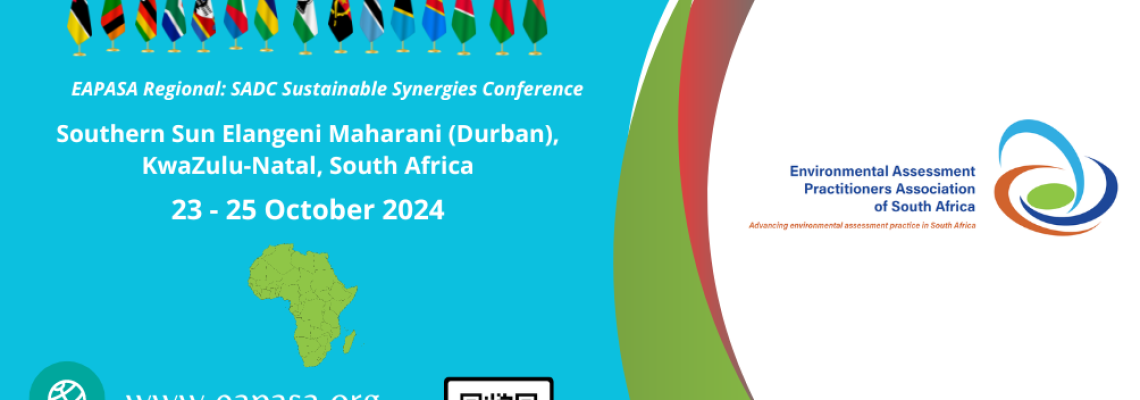
The EAPASA Regional Conference is an annual event that brings together environmental professionals from the Southern Africa Development Community (SADC) countries. The aim of the conference is to engage with other relevant professionals operating within the Environmental sector in Africa to find synergies that can assist in standardising the Environmental Assessment practice and develop guideline documents for Best Practice. These professionals can forge strong working relations, deliberate on critical environmental issues, and share knowledge on policies and legislation that best advances the environmental sector.
The 2024 conference will be held in Durban, KwaZulu-Natal Province, South Africa at Southern Sun Elangeni Maharani from 23 - 25 October 2024.
The conference theme is “EAPASA Regional: SADC Sustainable Synergies Conference”
You can look forward to keynote addresses, panel discussions, breakout sessions, welcome dinner, gala dinner, awards ceremony and more entertainment.

Although South Africa’s Constitution guarantees the right to sufficient water, many rural communities still face limited access to safe and reliable water supplies. Water security remains a major environmental and developmental challenge, particularly in the Eastern Cape. Environmental Assessment Practitioners (EAPs) play a key role in assessing the environmental and social impacts of water infrastructure projects such as dams, pipelines, wastewater treatment plants, and irrigation systems, helping to promote sustainable and equitable water resource development. Addressing these challenges requires interdisciplinary collaboration among practitioners, experts, and regulators. This theme invites abstracts covering technical water infrastructure assessments, water access and social justice, drought and climate change impacts, adaptation and mitigation strategies, and regional water scarcity, with a strong focus on sustainability and collaborative solutions.
According to the South African Heritage Resources Agency, palaeontological and geological sites are protected under the National Heritage Resources Act as part of South Africa’s national heritage. This theme explores the conservation and sustainable management of geological heritage, with particular focus on the globally significant fossil deposits of the Karoo Basin and the rich geological and palaeontological resources of the Eastern Cape. Abstracts are invited on heritage law and policy, fossil and geological research, implementation challenges of the Act, and conservation strategies that support the protection of these irreplaceable records of Earth’s history and evolution
Coastal ecosystems provide essential environmental services, including biodiversity conservation, climate regulation, coastal protection, and support for tourism and fisheries. Along the Eastern Cape’s Wild Coast, ecologically important habitats such as dunes, estuaries, wetlands, and coastal forests play a critical role in protecting shorelines, supporting biodiversity, and sustaining local livelihoods. However, these systems are increasingly threatened by coastal erosion, sea-level rise, storm surges, habitat degradation, illegal sand mining, and poorly planned development. Environmental Assessment Practitioners (EAPs) therefore play an important role in assessing climate-related risks and ensuring that Environmental Impact Assessments (EIAs) consider shoreline stability, flood vulnerability, sea-level rise projections, ecosystem sensitivity, and cumulative development impacts. Conference contributions exploring coastal resilience, climate adaptation, human impacts on coastal systems, and sustainable management approaches for protecting the Wild Coast are highly encouraged.
Environmental justice has become a critical focus within environmental governance, particularly in communities disproportionately affected by pollution, illegal dumping, and poorly managed waste disposal systems. Across South Africa, including the Eastern Cape, inadequate waste collection services, limited municipal infrastructure, and increasing illegal dumping continue to degrade environmental quality and threaten public health. In many areas, communities resort to burning waste, further contributing to air pollution and associated health risks. Environmental Assessment Practitioners (EAPs) play an important role in identifying environmental health risks, assessing community impacts during development planning, and ensuring that affected communities are included in decision-making through meaningful public participation processes. By connecting environmental governance with public health and social equity, this theme emphasises the need to integrate environmental justice principles into environmental assessment practice. Abstract submissions may explore policy and governance frameworks, the health and social impacts of waste mismanagement, case studies from the Eastern Cape, and the role of EAPs in promoting environmental justice through inclusive and participatory assessment processes.
Sustainable urban development and industrialisation in South Africa and other developing countries are major drivers of increasing waste generation and pollution. Rapid urbanisation, changing consumption patterns, and expanding industrial activities are placing significant pressure on municipal waste management systems, resulting in rising volumes of solid and hazardous waste, air emissions, and water pollution. Fast-growing cities such as Mthatha in the Eastern Cape are already experiencing environmental challenges, including water contamination, air pollution from waste burning, and associated public health risks due to inadequate waste infrastructure. Through Environmental Impact Assessment (EIA) and related planning processes, Environmental Assessment Practitioners (EAPs) play a key role in assessing waste management systems, pollution risks, and environmental health impacts of development projects. This conference theme invites abstracts on sustainable urban planning, integrated waste management, circular economy approaches, and improved environmental governance, with a focus on urbanisation- driven waste challenges, industrial and municipal pollution impacts, public health risks, and the role of EAPs in strengthening waste and pollution management systems.
Integrated Environmental Management (IEM) plays a key role in promoting policy and governance harmonisation within the SADC region, particularly through Environmental Impact Assessment (EIA) processes where Public Participation (PP) ensures inclusive, transparent, and accountable decision-making. The harmonisation of IEM, PP, and environmental assessment tools offers an opportunity to standardise policies, guidelines, methodologies, and implementation approaches across member states, thereby strengthening regional consistency and sustainability. In this context, Digital Environmental Systems (DESs)—including GIS, environmental screening tools, and web based platforms such as SAHRIS, SAMRAD, e-Wulaas, and NEAS—enhance data-driven decision-making, transparency, and regulatory efficiency. Overall, these developments support improved environmental governance, while enabling regional collaboration, standardised approaches, and shared strategies for addressing cross-border environmental challenges in the SADC region.
The SADC region is highly vulnerable to climate change impacts, experiencing increasing frequency and intensity of floods, droughts, cyclones, and heatwaves, which place significant pressure on infrastructure, agriculture, housing, tourism, and human livelihoods, particularly in rural and vulnerable communities. Disaster management is therefore a critical priority, focusing on reducing risk and strengthening resilience through early warning systems, climate-resilient infrastructure and agriculture, and effective adaptation strategies that support long- term sustainability. Submissions are encouraged that examine climate change impacts on vulnerable populations and explore disaster risk reduction, resilience- building measures, and the intersection of climate science, disaster management, and social equity within the SADC context.
The inclusion of professionalisation as a core theme of the EAPASA Regional Conference is both timely and strategic, aligning with South Africa’s commitment to building a capable and professionalised state. Environmental Impact Assessment (EIA), as a key decision-support tool, relies on the competence, ethics, and accountability of practitioners across the public sector, private consulting, and academia. Strengthening the professionalisation of environmental practice is therefore essential to enhancing the credibility, defensibility, and effectiveness of environmental governance systems. By foregrounding this theme, the conference contributes to a broader national and regional discourse on building a capable environmental sector equipped to address complex sustainability challenges with integrity and excellence. Globally, strong EIA systems are underpinned by certification and licensing, continuing professional development (CPD), codes of ethics, and peer review mechanisms. In this regard, abstracts exploring professionalisation frameworks, ethics, accountability, capacity building, and global best practices are encouraged, particularly those demonstrating how these approaches strengthen EIA practice and support a more capable and professionalised environmental sector in South Africa and the region.
Presenters can submit their abstracts based on the subthemes.
All Presenters are requested to upload the required information under this section.
Abstracts should not exceed 350 words. If an abstract is accepted, the presenting author is responsible for delivering the oral presentation. In the event of an emergency, an alternate may take the place of the presenting author.
The EAPASA Regional Conference is an annual event that brings together environmental professionals from the Southern Africa Development Community (SADC) countries. The aim of the conference is to engage with other relevant professionals operating within the Environmental sector in Africa to find synergies that can assist in standardising the Environmental Assessment practice and develop guideline documents for Best Practice. These professionals can forge strong working relations, deliberate on critical environmental issues, and share knowledge on policies and legislation that best advances the environmental sector.
The 2024 conference will be held in Durban, KwaZulu-Natal Province, South Africa at Southern Sun Elangeni Maharani from 23 - 25 October 2024.
The conference theme is “EAPASA Regional: SADC Sustainable Synergies Conference”
You can look forward to keynote addresses, panel discussions, breakout sessions, welcome dinner, gala dinner, awards ceremony and more entertainment.
The 5th EAPASA Regional Conference offers an opportunity to promote the organisation’s brand image, and to connect with Enviromental Professionals from around SADC.
For conference registration: Contact
Ms Tlohang Matlala at
Finance1@eapasa.org or call
012 880 2154
Conference details: Contact
Mr Muano Liphadzi at
Muano@eapasa.org or call
012 880 2154
For conference registration: Contact
Ms Tlohang Matlala at
Finance1@eapasa.org or call
012 880 2154
Conference details: Contact
Mr Muano Liphadzi at
Muano@eapasa.org or call
012 880 2154
Although South Africa’s Constitution guarantees the right to sufficient water, many rural communities still face limited access to safe and reliable water supplies. Water security remains a major environmental and developmental challenge, particularly in the Eastern Cape. Environmental Assessment Practitioners (EAPs) play a key role in assessing the environmental and social impacts of water infrastructure projects such as dams, pipelines, wastewater treatment plants, and irrigation systems, helping to promote sustainable and equitable water resource development. Addressing these challenges requires interdisciplinary collaboration among practitioners, experts, and regulators. This theme invites abstracts covering technical water infrastructure assessments, water access and social justice, drought and climate change impacts, adaptation and mitigation strategies, and regional water scarcity, with a strong focus on sustainability and collaborative solutions.
According to the South African Heritage Resources Agency, palaeontological and geological sites are protected under the National Heritage Resources Act as part of South Africa’s national heritage. This theme explores the conservation and sustainable management of geological heritage, with particular focus on the globally significant fossil deposits of the Karoo Basin and the rich geological and palaeontological resources of the Eastern Cape. Abstracts are invited on heritage law and policy, fossil and geological research, implementation challenges of the Act, and conservation strategies that support the protection of these irreplaceable records of Earth’s history and evolution
Coastal ecosystems provide essential environmental services, including biodiversity conservation, climate regulation, coastal protection, and support for tourism and fisheries. Along the Eastern Cape’s Wild Coast, ecologically important habitats such as dunes, estuaries, wetlands, and coastal forests play a critical role in protecting shorelines, supporting biodiversity, and sustaining local livelihoods. However, these systems are increasingly threatened by coastal erosion, sea-level rise, storm surges, habitat degradation, illegal sand mining, and poorly planned development. Environmental Assessment Practitioners (EAPs) therefore play an important role in assessing climate-related risks and ensuring that Environmental Impact Assessments (EIAs) consider shoreline stability, flood vulnerability, sea-level rise projections, ecosystem sensitivity, and cumulative development impacts. Conference contributions exploring coastal resilience, climate adaptation, human impacts on coastal systems, and sustainable management approaches for protecting the Wild Coast are highly encouraged.
Environmental justice has become a critical focus within environmental governance, particularly in communities disproportionately affected by pollution, illegal dumping, and poorly managed waste disposal systems. Across South Africa, including the Eastern Cape, inadequate waste collection services, limited municipal infrastructure, and increasing illegal dumping continue to degrade environmental quality and threaten public health. In many areas, communities resort to burning waste, further contributing to air pollution and associated health risks. Environmental Assessment Practitioners (EAPs) play an important role in identifying environmental health risks, assessing community impacts during development planning, and ensuring that affected communities are included in decision-making through meaningful public participation processes. By connecting environmental governance with public health and social equity, this theme emphasises the need to integrate environmental justice principles into environmental assessment practice. Abstract submissions may explore policy and governance frameworks, the health and social impacts of waste mismanagement, case studies from the Eastern Cape, and the role of EAPs in promoting environmental justice through inclusive and participatory assessment processes.
Sustainable urban development and industrialisation in South Africa and other developing countries are major drivers of increasing waste generation and pollution. Rapid urbanisation, changing consumption patterns, and expanding industrial activities are placing significant pressure on municipal waste management systems, resulting in rising volumes of solid and hazardous waste, air emissions, and water pollution. Fast-growing cities such as Mthatha in the Eastern Cape are already experiencing environmental challenges, including water contamination, air pollution from waste burning, and associated public health risks due to inadequate waste infrastructure. Through Environmental Impact Assessment (EIA) and related planning processes, Environmental Assessment Practitioners (EAPs) play a key role in assessing waste management systems, pollution risks, and environmental health impacts of development projects. This conference theme invites abstracts on sustainable urban planning, integrated waste management, circular economy approaches, and improved environmental governance, with a focus on urbanisation- driven waste challenges, industrial and municipal pollution impacts, public health risks, and the role of EAPs in strengthening waste and pollution management systems.
Integrated Environmental Management (IEM) plays a key role in promoting policy and governance harmonisation within the SADC region, particularly through Environmental Impact Assessment (EIA) processes where Public Participation (PP) ensures inclusive, transparent, and accountable decision-making. The harmonisation of IEM, PP, and environmental assessment tools offers an opportunity to standardise policies, guidelines, methodologies, and implementation approaches across member states, thereby strengthening regional consistency and sustainability. In this context, Digital Environmental Systems (DESs)—including GIS, environmental screening tools, and web based platforms such as SAHRIS, SAMRAD, e-Wulaas, and NEAS—enhance data-driven decision-making, transparency, and regulatory efficiency. Overall, these developments support improved environmental governance, while enabling regional collaboration, standardised approaches, and shared strategies for addressing cross-border environmental challenges in the SADC region.
The SADC region is highly vulnerable to climate change impacts, experiencing increasing frequency and intensity of floods, droughts, cyclones, and heatwaves, which place significant pressure on infrastructure, agriculture, housing, tourism, and human livelihoods, particularly in rural and vulnerable communities. Disaster management is therefore a critical priority, focusing on reducing risk and strengthening resilience through early warning systems, climate-resilient infrastructure and agriculture, and effective adaptation strategies that support long- term sustainability. Submissions are encouraged that examine climate change impacts on vulnerable populations and explore disaster risk reduction, resilience- building measures, and the intersection of climate science, disaster management, and social equity within the SADC context.
The inclusion of professionalisation as a core theme of the EAPASA Regional Conference is both timely and strategic, aligning with South Africa’s commitment to building a capable and professionalised state. Environmental Impact Assessment (EIA), as a key decision-support tool, relies on the competence, ethics, and accountability of practitioners across the public sector, private consulting, and academia. Strengthening the professionalisation of environmental practice is therefore essential to enhancing the credibility, defensibility, and effectiveness of environmental governance systems. By foregrounding this theme, the conference contributes to a broader national and regional discourse on building a capable environmental sector equipped to address complex sustainability challenges with integrity and excellence. Globally, strong EIA systems are underpinned by certification and licensing, continuing professional development (CPD), codes of ethics, and peer review mechanisms. In this regard, abstracts exploring professionalisation frameworks, ethics, accountability, capacity building, and global best practices are encouraged, particularly those demonstrating how these approaches strengthen EIA practice and support a more capable and professionalised environmental sector in South Africa and the region.
Presenters can submit their abstracts based on the subthemes.
All Presenters are requested to upload the required information under this section.
Abstracts should not exceed 350 words. If an abstract is accepted, the presenting author is responsible for delivering the oral presentation. In the event of an emergency, an alternate may take the place of the presenting author.
Nearby Accommodation | Contact |
|---|---|
African Perfection Guesthouse Beachfront suites |
|
Shaloha Guesthouse |
|
Salt Luxury Guest Apartments |
|
Beach Music Guesthouse |
|
Dirkies Dream Luxury Beachfront |
|
Supertubes Guesthouse |
|
Dreamland Apartments |
|
On the Beach Guesthouse |
|
Pinnaquin Holiday Apartments |
|
Greystone Guest House |
|
Marina Beach Lagoon |
|
IAP2 Way in Challenging Context EAPASA Training Poster_Final
Next-Generaation Environmental Management -Tools for a Sustainable World PDF
The EAPASA Regional Conference is an annual event that brings together environmental professionals from the Southern Africa Development Community (SADC) countries. The aim of the conference is to engage with other relevant professionals operating within the Environmental sector in Africa to find synergies that can assist in standardising the Environmental Assessment practice and develop guideline documents for Best Practice. These professionals can forge strong working relations, deliberate on critical environmental issues, and share knowledge on policies and legislation that best advances the environmental sector.
The 2024 conference will be held in Durban, KwaZulu-Natal Province, South Africa at Southern Sun Elangeni Maharani from 23 - 25 October 2024.
The conference theme is “EAPASA Regional: SADC Sustainable Synergies Conference”
You can look forward to keynote addresses, panel discussions, breakout sessions, welcome dinner, gala dinner, awards ceremony and more entertainment.
The Environmental Assessment Practitioners Association of South Africa (EAPASA) is pleased to announce the call for abstracts for the 4th EAPASA Regional Conference, themed “SADC Sustainable Synergies Conference.” The conference aims to bring together environmental professionals, researchers, and policymakers to share knowledge and best practices in achieving sustainable development and environmental stewardship in the SADC region.
The conference will focus on the following sub-themes:
We invite presenters to submit their abstracts based on the above sub-themes. Abstracts should not exceed 350 words and should be uploaded under this section. Please ensure that your abstract includes the following information:
– Title of the presentation
– Author(s) name(s) and affiliation(s)
– Brief overview of the presentation
– Closing date for submission of abstracts: 30 June 2026
– Closing date for submission of abstracts: 30 June 2026
Please note that presenters must register for the conference in order to be confirmed as a speaker in the program. To register, please click on this link: https://eapasa.glueup.com/
To submit your abstract, please upload your abstract through the link at the bottom of this page. We look forward to receiving your submissions and exploring the latest developments and innovations in environmental assessment and management in the SADC region.
For any queries or further information, please contact us. We are excited to see your submissions and look forward to a successful conference!”
Here is the link to be used:
https://docs.google.com/forms/d/e/1FAIpQLSc7Ai3eWKZzhMoF4m7xMXPvfK0BdaHshKYuua2HOj9lK5AC2Q/viewform
The 5th EAPASA Regional Conference offers an opportunity to promote the organisation’s brand image, and to connect with Enviromental Professionals from around SADC.
For conference registration: Contact
Ms Tlohang Matlala at
Finance1@eapasa.org or call
012 880 2154
Conference details: Contact
Mr Muano Liphadzi at
Muano@eapasa.org or call
012 880 2154
For conference registration: Contact
Ms Tlohang Matlala at
Finance1@eapasa.org or call
012 880 2154
Conference details: Contact
Mr Muano Liphadzi at
Muano@eapasa.org or call
012 880 2154
Although South Africa’s Constitution guarantees the right to sufficient water, many rural communities still face limited access to safe and reliable water supplies. Water security remains a major environmental and developmental challenge, particularly in the Eastern Cape. Environmental Assessment Practitioners (EAPs) play a key role in assessing the environmental and social impacts of water infrastructure projects such as dams, pipelines, wastewater treatment plants, and irrigation systems, helping to promote sustainable and equitable water resource development. Addressing these challenges requires interdisciplinary collaboration among practitioners, experts, and regulators. This theme invites abstracts covering technical water infrastructure assessments, water access and social justice, drought and climate change impacts, adaptation and mitigation strategies, and regional water scarcity, with a strong focus on sustainability and collaborative solutions.
According to the South African Heritage Resources Agency, palaeontological and geological sites are protected under the National Heritage Resources Act as part of South Africa’s national heritage. This theme explores the conservation and sustainable management of geological heritage, with particular focus on the globally significant fossil deposits of the Karoo Basin and the rich geological and palaeontological resources of the Eastern Cape. Abstracts are invited on heritage law and policy, fossil and geological research, implementation challenges of the Act, and conservation strategies that support the protection of these irreplaceable records of Earth’s history and evolution
Coastal ecosystems provide essential environmental services, including biodiversity conservation, climate regulation, coastal protection, and support for tourism and fisheries. Along the Eastern Cape’s Wild Coast, ecologically important habitats such as dunes, estuaries, wetlands, and coastal forests play a critical role in protecting shorelines, supporting biodiversity, and sustaining local livelihoods. However, these systems are increasingly threatened by coastal erosion, sea-level rise, storm surges, habitat degradation, illegal sand mining, and poorly planned development. Environmental Assessment Practitioners (EAPs) therefore play an important role in assessing climate-related risks and ensuring that Environmental Impact Assessments (EIAs) consider shoreline stability, flood vulnerability, sea-level rise projections, ecosystem sensitivity, and cumulative development impacts. Conference contributions exploring coastal resilience, climate adaptation, human impacts on coastal systems, and sustainable management approaches for protecting the Wild Coast are highly encouraged.
Environmental justice has become a critical focus within environmental governance, particularly in communities disproportionately affected by pollution, illegal dumping, and poorly managed waste disposal systems. Across South Africa, including the Eastern Cape, inadequate waste collection services, limited municipal infrastructure, and increasing illegal dumping continue to degrade environmental quality and threaten public health. In many areas, communities resort to burning waste, further contributing to air pollution and associated health risks. Environmental Assessment Practitioners (EAPs) play an important role in identifying environmental health risks, assessing community impacts during development planning, and ensuring that affected communities are included in decision-making through meaningful public participation processes. By connecting environmental governance with public health and social equity, this theme emphasises the need to integrate environmental justice principles into environmental assessment practice. Abstract submissions may explore policy and governance frameworks, the health and social impacts of waste mismanagement, case studies from the Eastern Cape, and the role of EAPs in promoting environmental justice through inclusive and participatory assessment processes.
Sustainable urban development and industrialisation in South Africa and other developing countries are major drivers of increasing waste generation and pollution. Rapid urbanisation, changing consumption patterns, and expanding industrial activities are placing significant pressure on municipal waste management systems, resulting in rising volumes of solid and hazardous waste, air emissions, and water pollution. Fast-growing cities such as Mthatha in the Eastern Cape are already experiencing environmental challenges, including water contamination, air pollution from waste burning, and associated public health risks due to inadequate waste infrastructure. Through Environmental Impact Assessment (EIA) and related planning processes, Environmental Assessment Practitioners (EAPs) play a key role in assessing waste management systems, pollution risks, and environmental health impacts of development projects. This conference theme invites abstracts on sustainable urban planning, integrated waste management, circular economy approaches, and improved environmental governance, with a focus on urbanisation- driven waste challenges, industrial and municipal pollution impacts, public health risks, and the role of EAPs in strengthening waste and pollution management systems.
Integrated Environmental Management (IEM) plays a key role in promoting policy and governance harmonisation within the SADC region, particularly through Environmental Impact Assessment (EIA) processes where Public Participation (PP) ensures inclusive, transparent, and accountable decision-making. The harmonisation of IEM, PP, and environmental assessment tools offers an opportunity to standardise policies, guidelines, methodologies, and implementation approaches across member states, thereby strengthening regional consistency and sustainability. In this context, Digital Environmental Systems (DESs)—including GIS, environmental screening tools, and web based platforms such as SAHRIS, SAMRAD, e-Wulaas, and NEAS—enhance data-driven decision-making, transparency, and regulatory efficiency. Overall, these developments support improved environmental governance, while enabling regional collaboration, standardised approaches, and shared strategies for addressing cross-border environmental challenges in the SADC region.
The SADC region is highly vulnerable to climate change impacts, experiencing increasing frequency and intensity of floods, droughts, cyclones, and heatwaves, which place significant pressure on infrastructure, agriculture, housing, tourism, and human livelihoods, particularly in rural and vulnerable communities. Disaster management is therefore a critical priority, focusing on reducing risk and strengthening resilience through early warning systems, climate-resilient infrastructure and agriculture, and effective adaptation strategies that support long- term sustainability. Submissions are encouraged that examine climate change impacts on vulnerable populations and explore disaster risk reduction, resilience- building measures, and the intersection of climate science, disaster management, and social equity within the SADC context.
The inclusion of professionalisation as a core theme of the EAPASA Regional Conference is both timely and strategic, aligning with South Africa’s commitment to building a capable and professionalised state. Environmental Impact Assessment (EIA), as a key decision-support tool, relies on the competence, ethics, and accountability of practitioners across the public sector, private consulting, and academia. Strengthening the professionalisation of environmental practice is therefore essential to enhancing the credibility, defensibility, and effectiveness of environmental governance systems. By foregrounding this theme, the conference contributes to a broader national and regional discourse on building a capable environmental sector equipped to address complex sustainability challenges with integrity and excellence. Globally, strong EIA systems are underpinned by certification and licensing, continuing professional development (CPD), codes of ethics, and peer review mechanisms. In this regard, abstracts exploring professionalisation frameworks, ethics, accountability, capacity building, and global best practices are encouraged, particularly those demonstrating how these approaches strengthen EIA practice and support a more capable and professionalised environmental sector in South Africa and the region.
Presenters can submit their abstracts based on the subthemes.
All Presenters are requested to upload the required information under this section.
Abstracts should not exceed 350 words. If an abstract is accepted, the presenting author is responsible for delivering the oral presentation. In the event of an emergency, an alternate may take the place of the presenting author.
Nearby Accommodation | Contact |
|---|---|
African Perfection Guesthouse Beachfront suites |
|
Shaloha Guesthouse |
|
Salt Luxury Guest Apartments |
|
Beach Music Guesthouse |
|
Dirkies Dream Luxury Beachfront |
|
Supertubes Guesthouse |
|
Dreamland Apartments |
|
On the Beach Guesthouse |
|
Pinnaquin Holiday Apartments |
|
Greystone Guest House |
|
Marina Beach Lagoon |
|
Download Mastering Negotiation Skills Brochure Below
Download Wetland Basics and a Bit More
Please note that the Registration Fees exclude
Early Bird Registration Closes 31 July 2026.
Standard Registration starts 01 August 2026.
BOOK YOUR SEAT NOW DUE TO LIMITED SPACE
REGISTRATION FEES (Standard) | EARLY BIRD |
|---|---|
Registered EAPs – R 6 950.00 | R 6 602.50 |
Candidate EAPs – R 6 450.00 | R 6 127.50 |
International delegates –R 7 950.00 | R 7 552.50 |
Local delegates (Nonregistered) – R 7 950.00 | R 7 552.50 |
Students (Undergraduate) –R 4 450.00 | R 4 277.50
|